How Do Silicone Rubber Seals Prevent Water Ingress in EV High-Voltage Connectors?
Water entering an EV high-voltage connector can corrode terminals, reduce insulation resistance, trigger isolation faults, shut down the vehicle, or create expensive warranty claims.
The effective solution is to use correctly compressed silicone rubber cable seals, interface seals, and perimeter gaskets at every possible water-entry path. Silicone rubber remains elastic across temperature changes and conforms to small dimensional variations between the cable, connector housing, and mating interface.
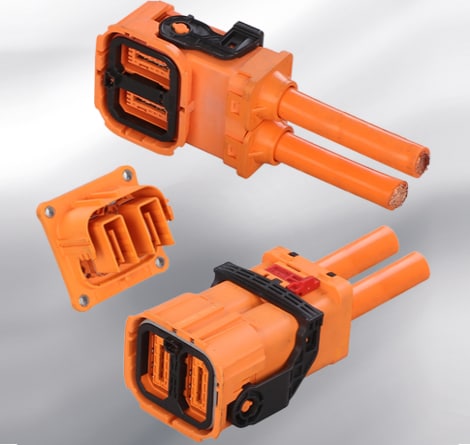
High-voltage automotive connectors designed for harsh EV environments. Image source: TE Connectivity .[4]
How Does a Silicone Seal Block Water?
An uncompressed, twisted, cut, or incorrectly sized seal leaves a microscopic path that allows water, road salt, and coolant to reach high-voltage terminals.
The solution is to maintain controlled radial or axial compression around the cable and connector interface. Silicone rubber deforms against the mating surfaces and creates continuous contact pressure. Low compression set helps the seal maintain this pressure after vibration, heat aging, and repeated temperature cycling.
Automotive liquid silicone rubber grades are specifically available for connector seals, weather-pack seals, radial seals, and gaskets. Certain self-lubricating grades also reduce insertion force and help prevent seal damage during automated assembly.[1]
Which Seal Design Problems Cause Water Ingress?
Even high-quality silicone can leak when the groove is too shallow, the cable diameter is outside tolerance, molding flash crosses the sealing surface, or the seal is damaged during terminal insertion.
The correct solution is to design the seal, housing, cable, and assembly process as one controlled system. Seal hardness, lip geometry, compression ratio, cable outer diameter, surface finish, parting line, lubricant level, and connector tolerances must all be validated together.
Seal Risk
Possible Failure
Recommended Control
Insufficient compression
Open water path around the seal
Control groove depth and seal dimensions
Excessive compression
Seal tearing or connector deformation
Validate insertion force and compression ratio
Incorrect cable diameter
Leakage around the cable seal
Match the seal cavity to cable OD tolerance
Molding flash or contamination
Interrupted sealing contact
Inspect sealing lips and control cleanliness
Thermal compression set
Loss of sealing pressure over time
Select low-compression-set silicone rubber
WACKER offers automotive connector-seal silicone grades with low compression set, cut resistance, electrical properties, and service capability across a wide temperature range.[2]The published material range must not automatically be treated as the temperature rating of the complete connector.
How Should a Sealed High-Voltage Connector Be Tested?
A connector that appears watertight after assembly may begin leaking after vibration, cable movement, pressure washing, thermal cycling, or seal aging.
The solution is to test the fully assembled and mated connector after environmental conditioning. ISO 20653 defines protection levels and test methods for road-vehicle electrical equipment exposed to foreign objects and water.[3]
Validation should include immersion, high-pressure spray, thermal cycling, vibration, cable pull, pressure decay, insulation resistance, and dielectric withstand testing. TE lists IP67 and IP6K9K protection for specified mated high-voltage connector systems, but an IP rating applies only to the exact tested configuration and assembly condition.[4]
Need a Silicone Seal or EV Connector Sample Review?
Send your connector drawing, cable diameter, seal dimensions, temperature range, fluid exposure, target IP rating, and annual demand for material selection or prototype evaluation.
FAQ
Why is silicone rubber used for EV connector seals?
Silicone rubber provides flexibility, electrical insulation, temperature resistance, and low compression set for long-term connector sealing.
Does a silicone seal make every connector waterproof?
No. Waterproof performance also depends on seal compression, cable diameter, housing tolerances, connector mating, and assembly quality.
What causes an EV connector seal to leak?
Common causes include damaged sealing lips, incorrect cable diameter, molding flash, contamination, poor compression, and incomplete connector mating.
Is IP67 enough for a high-voltage EV connector?
It depends on the installation environment. Underbody or pressure-wash locations may require IP6K9K or additional OEM-specific testing.
15-Year Automotive Wire Harness Sealing Review
Based on 15 years of automotive wire harness experience, I recommend evaluating the silicone seal together with the cable diameter, terminal, housing, backshell, connector lock, and assembly process. The best seal is not simply the softest rubber; it is the seal that maintains controlled compression after heat, vibration, water exposure, and real vehicle operation.
We use cookies to enable all functionalities for best performance during your visit and to improve our services by giving us some insight into how the website is being used. Continued use of our website without having changed your browser settings confirms your acceptance of these cookies. For details please see our privacy policy.