Publish Time: 2024-08-22 Origin: Site
A trailer wiring harness carries lighting signals and, where equipped, brake-control and auxiliary circuits between a tow vehicle and trailer. Incorrect connections can disable lights or damage wiring. Choose by electrical requirements, not towing weight alone.
Undersized conductors or poorly sealed plugs can cause voltage drop, corrosion, and intermittent lamps.
Specify the connector pinout, circuit current, cable length, insulation, and sealing for the installation.
Wire gauge affects current capacity and voltage drop; abrasion resistance depends on insulation and routing. Extra cable length adds resistance and can snag. Color coding helps identification but never replaces pinout verification.
Connector: Match plug geometry and terminal functions.
Conductor: Size for load, length, and circuit protection.
Routing: Avoid hot parts, sharp edges, and moving equipment.
Sealing: Check connector gaskets, strain relief, and water exposure.
Harness Design Checks
Pinout and fit
Load and fuse
Gauge and length
Seal and secure
Illustration 1: conceptual selection checklist, not a vehicle-specific wiring diagram.
Matching the plug shape alone may leave trailer brakes or auxiliary circuits disconnected.
Confirm both mating pinouts, vehicle interface, and every required electrical function.
Four-way flat connectors commonly provide basic North American lighting; seven-way versions can add brake control and auxiliary feeds. Some vehicles need a model-specific T-harness or powered converter. Verify the installation against the CURT wiring guide.
| Check | Required Information | Risk if Missed |
|---|---|---|
| Connector | Pinout and mating style | Wrong signals |
| Cable | Current, length, gauge | Voltage drop |
| Environment | Water, abrasion, heat | Premature failure |
For a drawing review, send the vehicle interface, trailer pinout, load list, and cable routing plan. View trailer wiring harness products.
Moisture intrusion or cable abrasion can leave trailer lighting unreliable before a trip.
Inspect terminals, seals, grounds, and exposed cable runs before towing.
Remove debris with connector-approved methods; replace damaged seals or terminals. Cap disconnected plugs, avoid tight bends, and support cables above the road. Use sealed repair components where specified, rather than relying on ordinary tape for waterproofing.
Check for corrosion, loose contacts, and cracked insulation.
Confirm grounding and all lamp functions after reconnecting.
Keep unused connector ends capped and dry.
Pre-Tow Maintenance Sequence
Plug and cable
Seal and route
Lights and brakes
Illustration 2: inspection workflow; trailer brake tests apply where brakes are fitted.
An apparently secure connector can still have reversed circuits or a high-resistance ground.
Operate each lighting function and test electric brakes separately where installed.
Check brake lamps, turn signals, tail lamps, and applicable reverse or auxiliary circuits. If a fuse trips, diagnose the short or overload without increasing its rating.
Does trailer wiring depend on towing capacity?
Electrical wiring is sized by circuit load and installation conditions; the vehicle's mechanical towing rating is separate.
Is a longer trailer harness better?
Only if needed for routing. Excess length increases voltage drop and creates snag risks.
Can electrical tape waterproof a trailer connector?
Not reliably. Use a correctly assembled sealed connector or an approved repair system.
Are trailer wire colors universal?
No. Confirm each terminal against the applicable connector diagram.
Select the harness by pinout, circuit load, protection, and exposure, then verify every function before towing. Send your electrical drawing, connector details, and quantities to request an engineering evaluation or quote.
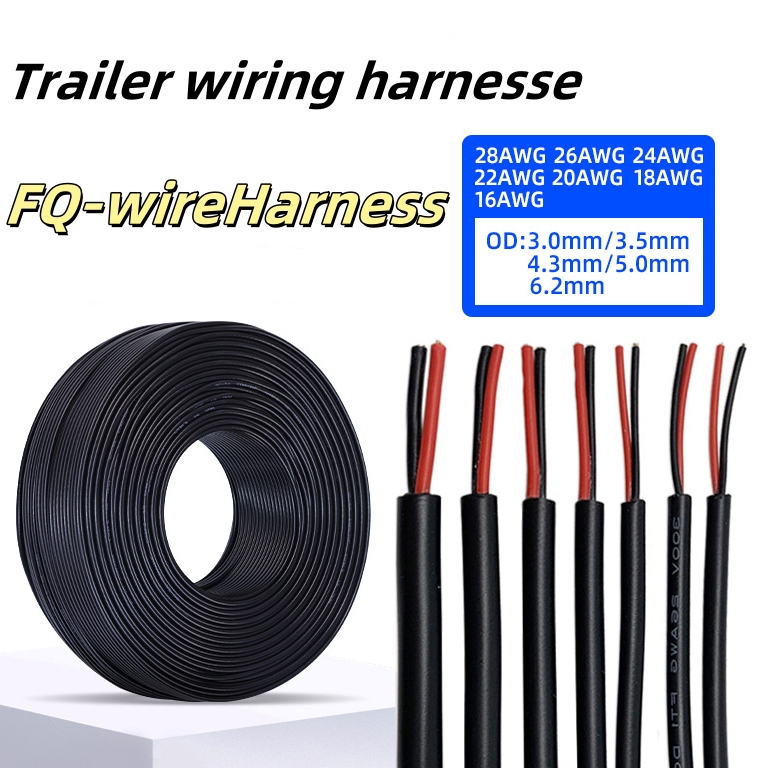
Original article trailer wiring harness image (check product relevance before reuse). Explore trailer wiring harness options.
15 Years of Automotive Wire Harness Industry Experience
Our 15 Years of Automotive Wire Harness Industry Experience covers harness design, material selection, manufacturing, and quality control. Customer projects require technical validation against approved drawings, circuit loads, and inspection criteria.